
Axonis Decision Intelligence
Every AI-assisted decision accounted for with a flexible toolkit for decision workflows
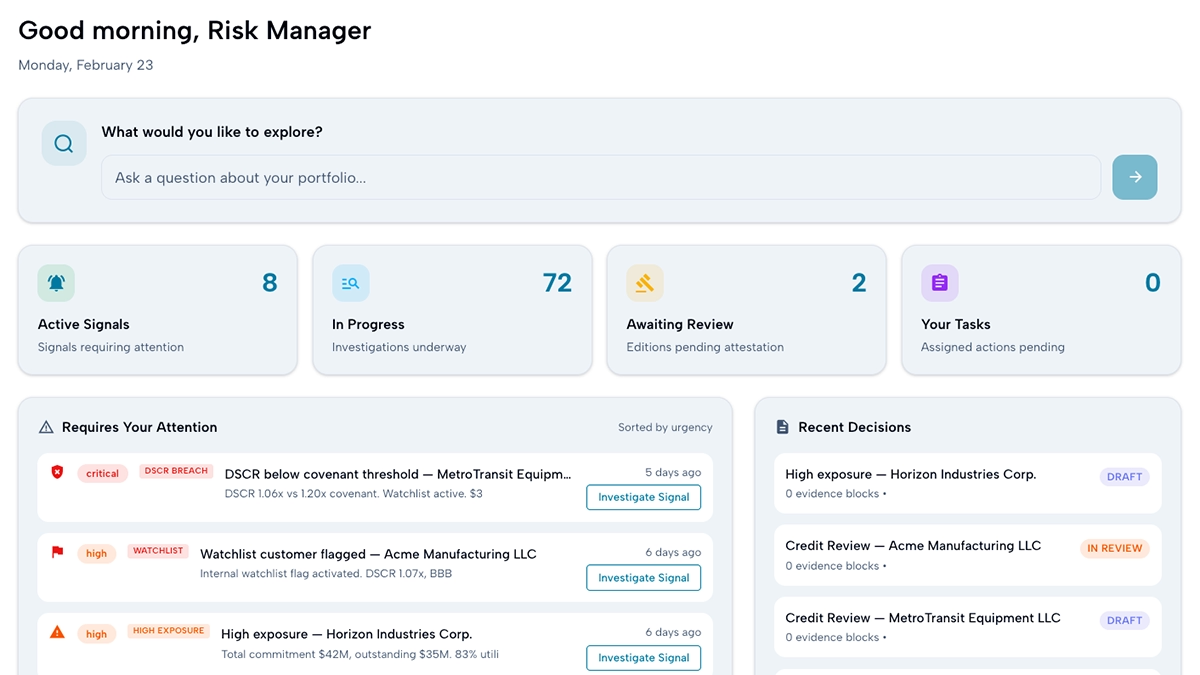
AI decisions grounded in evidence
If you can't prove how an AI-assisted decision was made — what data informed it, which policies governed it — you're exposed. But there's a second problem most organizations miss: you're also flying blind on whether your decisions are actually good.
Axonis Decision Intelligence fixes both. It embeds governance into execution, so every AI-assisted decision is grounded in your actual data and preserved as an auditable record. And once you have those records, you can use AI to analyze patterns, catch drift, and continuously improve how decisions get made across your organization.
Every decision leaves a traceable record
Structured human-AI collaboration with a full audit trail
A system-of-record for AI-assisted decisions
Built on Axonis’ AI-native federated platform, Decision Intelligence enables enterprises to capture, explain, audit, defend, and revisit AI-assisted decisions without centralizing or moving sensitive data.
Decision traces are captured in the execution path — across cloud, on-prem, edge, air-gapped, and intermittently connected environments.
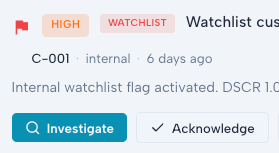
Monitor & Explore
Configure signals based on your data
- Alert users to issues and incidents that need attention
- Explore the data available to them through the Axonis data space
- Move an incident to an active investigation
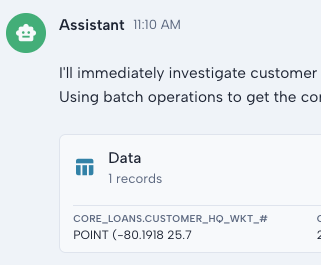
Investigate & Analyze
Engage an AI assistant to analyze the data
- Natural language AI chat with any LLM (pluggable) or model
- Recommended queries for follow-up analysis
- AI recommendations on next steps and resolution paths
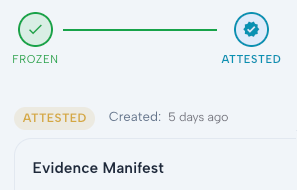
Freeze & Attest
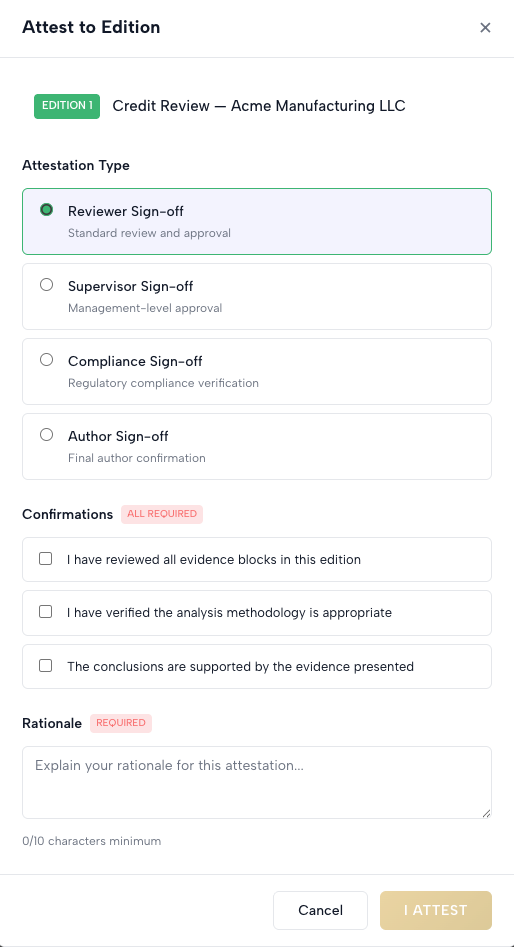
Pin evidence and create a decision
- Users pin relevant evidence and approves the manifest
- Evidence + AI chat + decision notes can be attested & recorded
- Reviewer can replay the decision record
A toolkit for AI-enabled decision workflows
Axonis Decision Intelligence is a solution that includes the Axonis platform, plus an infinitely customizable reference application that can be quickly adapted to any decision-centric use case, such as:
- Case management
- Risk management
- Investigations
- Compliance reviews
- Incident response
Contact us today to see a demo and discuss your use decision-centric agentic or human-in-the loop use case.
Frequently Asked Questions
How It Works
How does Axonis access data if it never leaves its boundary?
Axonis deploys lightweight compute nodes directly next to your data sources. These nodes perform everything locally: feature engineering, transformation, training, and inference. Only encrypted model updates or aggregated statistics leave the boundary, never raw data. This dramatically reduces your security footprint compared to centralization.
How does federated learning work on Axonis?
Each site trains models locally on its own production data. Axonis securely aggregates the model parameters, builds a global model, and returns updated model weights to each location. Axonis also maintains compliance and data-level security at every step of the lifecycle.
What’s the difference between horizontal, vertical, and transfer federated learning?
- Horizontal Federated Learning: Same schema, different rows (stores, regions, hospitals).
- Vertical Federated Learning: Different attributes for the same entities split across systems or companies (bank risk + merchant data).
- Federated Transfer Learning: Used when both features and samples differ but shared learning improves accuracy.
Axonis supports all three natively and does so on real production data. Most federated learning tools do not.
How does federated feature engineering work, especially for operations like PCA?
- Axonis computes statistics locally (covariances, means, summaries), securely aggregates them across sites, and derives global values without exposing raw data. This enables advanced transformations - PCA, normalization, embeddings - while keeping all sensitive data in place.
How does Axonis integrate with the existing ML stack?
Axonis is designed for interoperability, not replacement. It works with your existing ecosystem:
- ML Frameworks: PyTorch, TensorFlow, JAX, XGBoost, Keras
- Pipeline Tools: Airflow, Kubeflow, MLflow
- Access & Identity: Keycloak
- Serving: Built-in serving or export to your existing cloud-hosted serving stack
You retain full ownership and portability of your trained models and can serve them in any environment. Axonis does not require proprietary serving infrastructure.
Performance, Scalability & Cost
How does inference performance compare to centralized models?
Inference happens next to the data, not across a network. This avoids latency, cloud routing, and regional bottlenecks. The result is faster, more predictable performance, especially in edge or multi-region scenarios.
How does Axonis improve ML pipeline speed?
Axonis eliminates multi-TB data transfers, reduces ETL and cleaning, and trains models across all sites in parallel. Instead of waiting months to engineer production integration, models can be served immediately because Axonis is already wired into live systems.
How does Axonis reduce cloud and infrastructure costs?
By keeping data where it is:
- No data duplication
- No egress fees
- No cloud storage of sensitive data
- Minimal cloud compute for preprocessing
- Reduced cybersecurity surface area (fewer systems to secure)
Axonis customers frequently cut cost by 50–75% compared to centralized AI architectures, based on Axonis customer deployments.
Can Axonis scale with enterprise workloads?
Yes. Axonis was built for everything from a single on-prem GPU to massive cloud clusters. It handles edge nodes, air-gapped boxes, hybrid clouds, and large multi-region federations.
Security, Zero Trust & Compliance
Is Axonis secure?
Yes. Axonis is built on zero-trust architecture proven in DoD and U.S. intelligence community deployments – environments where security requirements exceed every commercial compliance framework. The platform was hardened inside T2S Solutions serving IC programs before Axonis launched commercially in December 2025. Security requirements in those environments are stricter than any commercial sector. It is often recognized as a “superset” of all commercial compliance frameworks.
Key security features include:
- Data-level security (fine-grained field-level controls)
- Zero-trust architecture
- Localized model training (no raw data ever leaves)
- Secure aggregation
- Full auditability, monitoring, and logging
Encryption in transit and at rest
What compliance standards does Axonis support?
Axonis aligns with global standards including: HIPAA, PHI/PII, PCI-DSS, HITRUST HIGH, SOX, ICD-503 (the security directive governing U.S. intelligence community systems), GDPR, CCPA, LGPD, POPI, SOC 2, ISO 27001.
Federated learning also reduces compliance risk by minimizing data movement.
Technical Capabilities
What data sources can Axonis connect to?
Nearly any system including commercial, legacy, open source, or proprietary environments:
S3, GCS, Azure Blob, PostgreSQL, MySQL, Oracle, Snowflake, BigQuery, Redshift, Hive, HDFS, MongoDB, Elasticsearch, FTP/SFTP, REST APIs, and many more.
What data types are supported?
Axonis handles all modalities: structured, unstructured, logs, time-series, text, images, video, sensor/telemetry streams, and multimodal combinations.
Does Axonis support no-code development?
Yes. Modelers and data scientists can:
- Explore and visualize data
- Perform distributed feature engineering
- Build and evaluate models
- Deploy models instantly to production systems
Code-first users can bring their own frameworks and libraries.
What model formats does Axonis support?
Industry standards including ONNX, TensorFlow SavedModel, TorchScript, XGBoost, MXNet, and full export to external serving stacks.
Does Axonis replace pipeline tooling like Airflow?
No. Axonis integrates with Airflow and other orchestrators. It enhances your pipelines by enabling federated compute and in-place model training, rather than replacing existing workflows.
Commercial & Deployment
Where can Axonis be deployed?
Anywhere:
- On-premises (server, cluster, or isolated environment)
- Any major cloud
- Hybrid architectures
- Edge sites, factories, and branch locations
- Fully air-gapped environments
- Multi-agency or multi-subsidiary federations
Does Axonis require data migration?
No. Axonis was designed specifically so companies can avoid multi-year migrations, cloud re-architecture, or consolidation projects. You start using your production data immediately.
How long does it take to get started?
Most organizations connect initial systems and begin federated training in typically 2 to 5 days, without requiring data migration or infrastructure overhaul
Decision Intelligence
What is Axonis Decision Intelligence?
Axonis Decision Intelligence operationalizes AI-assisted decision-making by capturing every AI-assisted decision as a structured, auditable record: the evidence used, the model that produced it, the policy context applied, and the human attestations associated with it. AI decisions stop being black boxes and become defensible, reviewable artifacts that regulators, auditors, and internal reviewers can inspect at any time.
How does Axonis create an audit trail for AI decisions?
Every AI-assisted decision processed through Axonis is recorded with its full decision trace: the input data, the model version and configuration, the inference result, the policy constraints in effect at the time, and any human review or attestation actions. This creates a living system of record that survives audit, regulatory review, and internal investigation.
Can Axonis prove why an AI made a specific recommendation?
Yes. When a regulator or auditor asks why the AI recommended a particular action, Axonis provides a complete decision trace: the data inputs, the model and version used, the policy constraints active at decision time, and the chain of human attestations. AI recommendations become accountable records, not unexplained outputs.
How does Decision Intelligence support AI explainability and compliance requirements?
Emerging AI regulations -- including EU AI Act requirements, SR 11-7 model risk management guidance for financial services, and healthcare AI accountability standards -- require organizations to explain and justify AI-assisted decisions. Axonis Decision Intelligence provides the structured evidence trail that makes AI decisions legible to regulators without requiring organizations to rebuild their AI infrastructure.
Federated MCP (Agentic AI Governance)
What is Axonis Federated MCP?
Axonis Federated MCP is an enterprise implementation of the Model Context Protocol (MCP) that embeds governance and security controls directly into AI agent workflows. Even agentic AI systems -- autonomous agents that act across systems and data sources -- operate within enforced data access boundaries and cannot reach data they are not authorized to touch.
How does Axonis govern AI agents in regulated environments?
Axonis Federated MCP iStandard MCP deployments give AI agents broad data access that is incompatible with regulated environments. Axonis Federated MCP extends the zero-trust security perimeter into the agentic layer: every agent action is governed by the same data-level access controls, authorization policies, and audit logging that apply to the rest of the Axonis platform.s an enterprise implementation of the Model Context Protocol (MCP) that embeds governance and security controls directly into AI agent workflows. Even agentic AI systems -- autonomous agents that act across systems and data sources -- operate within enforced data access boundaries and cannot reach data they are not authorized to touch.
Can AI agents access sensitive data securely under Axonis?
Yes. Axonis Federated MCP allows AI agents to be deployed in regulated, classified, and multi-organizational environments without creating new security or compliance exposure. Agents see only what they are authorized to see. They cannot exfiltrate data, escalate privileges, or act outside their authorized scope.