
You Create AI Context. You Just Don’t Own It
Enterprise AI is already generating decision context across your organization. The real risk isn’t creation, it’s failing to own, govern, and preserve it.
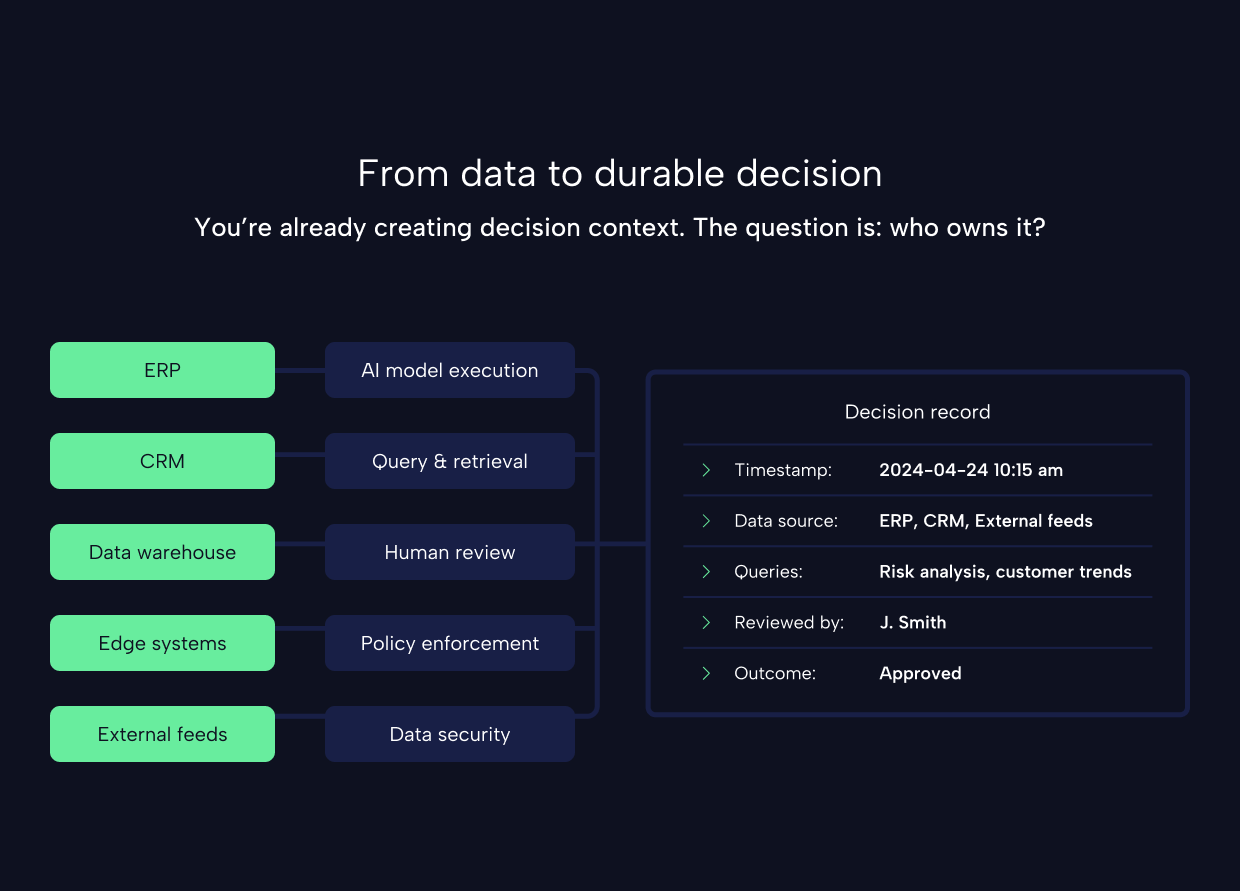
There’s a growing conversation in enterprise AI around things like “context graphs” and “reasoning layers,”* often framed as future capabilities, systems we’ll intentionally design once the rest of the AI stack matures.
But here’s the more practical reality: Most organizations are already generating decision context at scale. They just don’t own it.
Every AI Interaction Creates More Than Data
Every time a human uses AI at work, asking a question, refining a query, reviewing an output, or approving a recommendation, they are creating more than data. They’re creating decision context:
- what triggered the investigation
- which data sources were considered relevant
- how conflicting signals were weighed
- what evidence mattered most
- why a particular action was taken or not taken
That context is not incidental. It’s the institutional knowledge behind how decisions actually get made. And it’s all captured in the conversations between your employees and LLMs.
But in most organizations today, it disappears the moment the decision is reached or worse, it ends up fragmented across chat tools, documents, dashboards, and AI platforms the enterprise doesn’t own.
The NOW Challenge of Enterprise AI
The hard problem in enterprise AI isn’t model quality. It’s ensuring that AI-assisted decisions are trusted, traceable, and accountable over time.
At Axonis, we believe the missing layer isn’t another model or dashboard. It’s a system that treats decision context itself as a durable enterprise asset, one that can be preserved, governed, reviewed, and reused across teams, systems, and AI models.
Because when you can’t see how decisions were made, you can’t improve them, defend them, or scale them responsibly. More urgently, new AI regulations (like the EU AI act) will require that you can demonstrate how AI-assisted decisions were made.
A Practical Reframe
Here’s the reframing that matters: This isn’t about building a “graph” as a feature. It’s about capturing decisions as structured, replayable records. Every AI-assisted decision already has:
- a starting signal or intent
- a set of data queries or retrievals
- intermediate reasoning (human and machine)
- and a final outcome
The question is whether that chain of reasoning is:
- ephemeral or durable
- scattered or structured
- owned by the enterprise or embedded in third-party tools
LLMs will change. Vendors will change. Owned decision context compounds.
That’s the bet behind Axonis Decision Intelligence.
Context Isn’t Just Data. It’s How Decisions Happen
Enterprises have spent decades building strong data foundations: access controls, governance, lineage, auditability. All of that remains essential. But AI changes what’s valuable.
The most important asset isn’t just the underlying data. It’s the reasoning that happens when humans and AI work with that data together. That reasoning doesn’t live neatly in a table or a report. It lives in:
- why a question was asked in the first place
- which data was trusted or ignored
- how contradictions were resolved
- why a recommendation was accepted, revised, or rejected
Today, most systems capture the decision, not the path that led to it. You can see what happened, but not why.
A Lesson from the Intelligence Community
This problem isn’t new. It’s long been understood in intelligence and defense environments, where decision traceability is non-negotiable. An analyst may produce an assessment based on multiple sources. Action is taken. Later, one of those sources is discredited.
The critical question isn’t simply “was the decision right?” It’s:
- How dependent was the decision on that source?
- Was it foundational or merely corroborative?
- Does the conclusion still stand given what we now know?
Those questions can only be answered if the decision context was captured at the time, not reconstructed after the fact.
Enterprise decision-making works the same way, just with different inputs: financial systems, operational data, customer signals, external feeds. Without a way to preserve the reasoning, organizations are forced to relearn the same lessons repeatedly, or accept gaps in their institutional memory.
Turning AI-Assisted Decisions into First-Class Artifacts
This is the problem Axonis Decision Intelligence is designed to solve. Instead of treating AI interactions as transient conversations, Axonis treats decisions as first-class artifacts, durable records of how a decision was formed.
A decision record in Axonis links:
- the underlying data and systems involved (without centralizing them)
- the queries, aggregations, or retrieval steps used
- the human and AI reasoning applied
- and the final decision, including explicit “no action” outcomes
These elements are captured in an append-only decision ledger that can be replayed, reviewed, and audited over time. Sometimes that context needs to be frozen to reflect exactly what was known at a moment in time. Other times it needs to evolve as new information emerges. Both are essential.
What matters is that the enterprise owns the record.
Your Organization Is Already Creating This Context
The choice isn’t whether decision context will exist. It already does. every time employees use AI as a thought partner. The real question is where that context lives.
Today, much of it lives inside tools that were never designed to serve as systems of record for decision-making. Even if vendors don’t train on your data, that doesn’t mean the context is accessible, reusable, or governable by your organization.
If you don’t own your decision context, you can’t:
- analyze how decisions are actually being made
- reuse institutional reasoning across teams
- adapt AI systems without losing historical insight
You lose continuity just as AI becomes more central to operations.
Assume Models Will Change
One assumption worth challenging is that enterprises will standardize on a single AI model long-term. In reality, models will continue to evolve. Different teams will favor different tools. New models will outperform old ones on cost, speed, or specialization.
That makes the layer above the models strategically important.
Axonis allows organizations to change models over time while preserving what matters most: the decision context itself.
The intelligence stays with the enterprise, not the model provider.